
B to Bern (B2Bern)
I co-built B to Bern (B2Bern), an award-winning agentic AI research navigator connecting companies with source-backed expertise across Bern's research ecosystem.
- Problem
- Connect company needs to relevant public research and expertise in Bern.
- My contribution
- Co-built a research navigator with a four-person hackathon team.
- Result
- Won the Bern Economic Development Agency track and placed second overall at Hack Apertus 2026.
- Scope and limitations
- Hackathon prototype; subsystem ownership is shared and production performance has not been established.
Technical documentation
B to Bern (B2Bern)
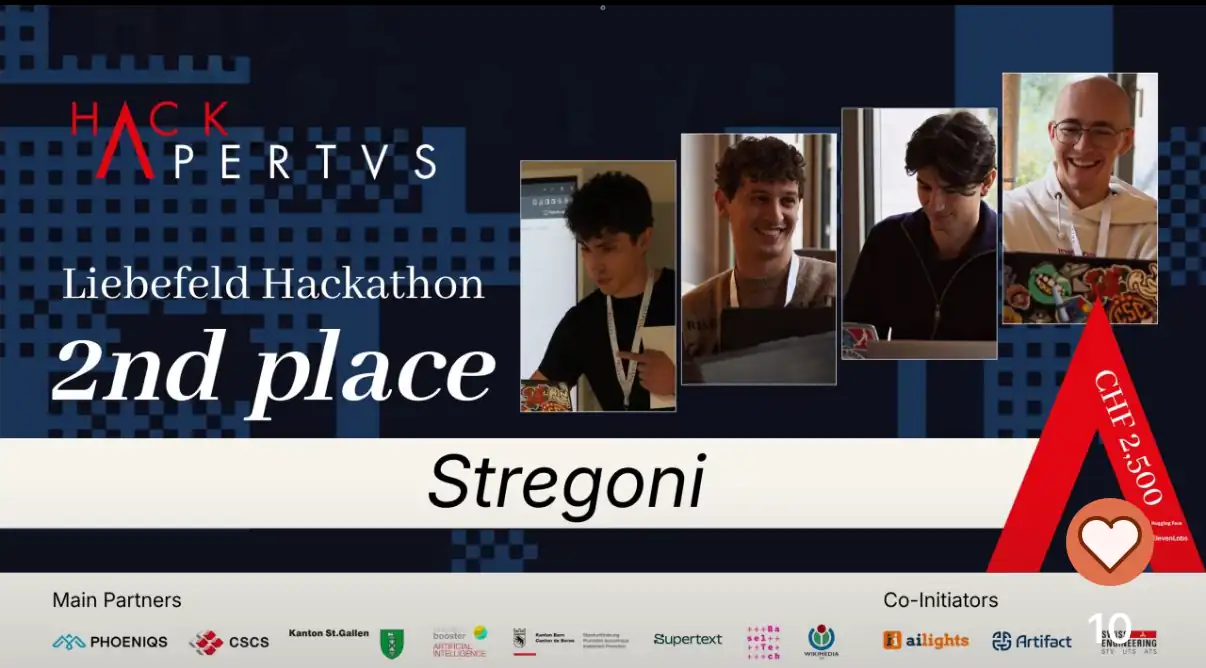
An agentic AI research navigator that connects a company's technical needs with evidence-backed research capabilities in Bern, Switzerland.
Hack Apertus 2026: 2nd place overall and winner of the Bern Economic Development Agency challenge track. Built by Team Stregoni in approximately 24 hours. The award included CHF 2,500, additional prizes, and an invitation to showcase the project at DINAconCH.
Source code and technical documentation
The problem
For a company evaluating Bern as a location for R&D, finding relevant academic expertise is not straightforward. Researchers, projects, laboratories, and facilities are described across different institutional sites, often using terminology that does not match a company's own language.
The Bern Economic Development Agency proposed a practical challenge: make the public research ecosystem easier to navigate, and explain why a specific research group or capability might matter to a prospective company.
B2Bern turns an ordinary-language company brief into an inspectable set of research matches and a source-backed "Why Bern?" report. Its initial biomedical pilot focuses on publicly available institutional pages and research publications associated with the University of Bern, ARTORG Center for Biomedical Engineering Research, and Diabetes Center Berne.
How the agentic workflow works
The application uses Apertus v1.5 70B for interpretation and evidence reasoning, with LangGraph coordinating bounded research stages and LangChain providing tool abstractions.
- Interpret the company's intent. Apertus extracts the company's objectives, technical requirements, and constraints. A versioned MeSH biomedical taxonomy helps connect everyday terms, such as glucose sensors, with relevant scientific vocabulary. The workflow can request clarification when essential information is missing.
- Research in parallel. The LangGraph workflow invokes tools for hybrid retrieval over a curated institutional knowledge base and for public web discovery and source retrieval. The provided challenge materials included a list of public university subdomains as discovery leads—not a complete, ready-made dataset.
- Retrieve and rank evidence. The knowledge base uses PostgreSQL full-text search and pgvector semantic retrieval with EmbeddingGemma 2. Independent results are combined using reciprocal rank fusion (RRF), with optional reranking. Retrieved evidence retains source URLs, exact passages, and provenance.
- Assess relevance and factual support. Apertus extracts candidate claims and evaluates which findings fit the company's requirements. Code checks source references and exact supporting text, while semantic assessment distinguishes supported findings from uncertain, incomplete, or unsupported claims. Research can be extended when important evidence gaps remain.
- Draft and review. Apertus synthesizes the supported evidence into a cited "Why Bern?" report. An operator can inspect original sources, keep or reject proposed reasons, revise the brief, and approve the selected results before export.
The result is more than document search: the model interprets a business need, participates in assessing the research evidence, and explains the connection between specific capabilities and that need. The workflow retains human review instead of presenting every generated suggestion as established fact.
Architecture and implementation
| Layer | Implementation |
|---|---|
| Language model | Apertus v1.5 70B, accessed through Keera using CSCS-backed inference |
| Agent orchestration | LangGraph, LangChain tools and task adapters |
| Research knowledge base | Public institutional webpages and research PDFs; PostgreSQL with pgvector |
| Hybrid retrieval | Full-text + EmbeddingGemma 2 vector search, RRF fusion, optional cross-encoder reranking |
| Domain vocabulary | Versioned MeSH biomedical taxonomy |
| Public-source research | Bounded web discovery, fetching and source registration; new pages remain identified separately from the curated corpus |
| Output and review | Evidence-backed reason cards, citations to original passages, human keep/reject decisions, reviewed report export |
The workflow has explicit boundaries between source discovery, evidence validation, report drafting, and final human approval. A retrieved snippet or semantic similarity score alone is not treated as proof of a factual claim.
Result and scope
- 2nd place overall at Hack Apertus Liebefeld 2026, and winner of the Bern Economic Development Agency challenge track.
- Built an integrated agentic AI prototype in approximately 24 hours, demonstrating a concrete economic-development use case for Switzerland's open language model.
- Awarded CHF 2,500 and additional prizes, including the opportunity to present the project at DINAconCH.
- Published the code, architecture, verification notes, and limitations.
Engineering status: This is a hackathon prototype, not a production-certified research directory. The repository documents automated component checks, isolated real-Apertus workflow cases, and an initial live-corpus partial report. Comprehensive expert-rated retrieval quality, complete institutional coverage, and a fully independent air-gapped deployment have not been demonstrated. Citations support inspection; they do not establish that a researcher is currently available for collaboration.
Hackathon photos
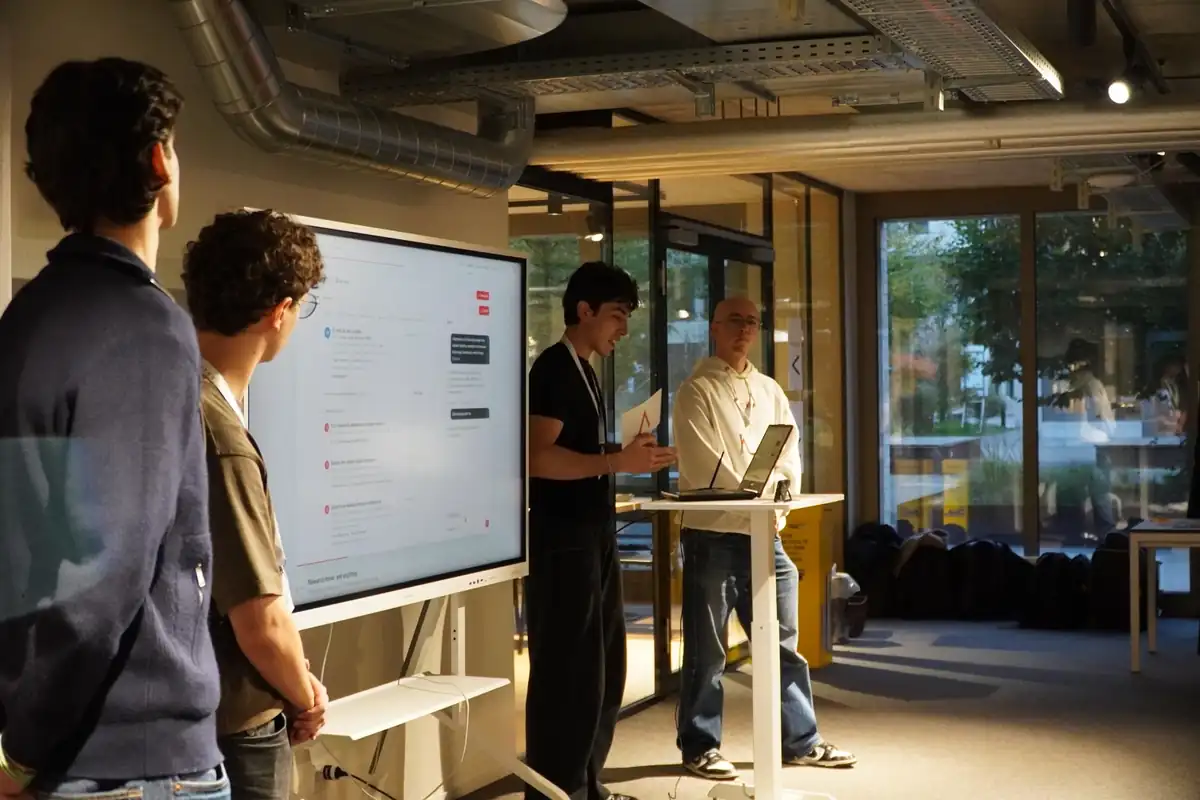
Presenting the prototype during the final hackathon session.
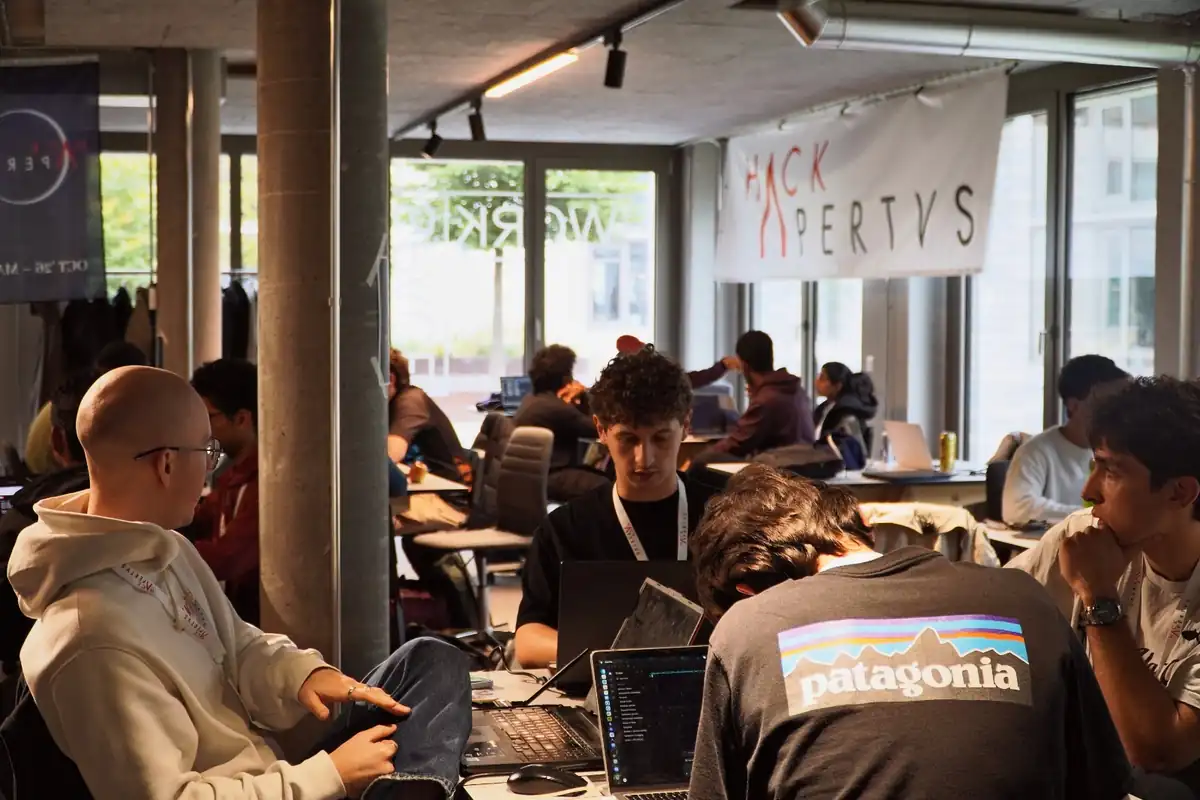
Building and testing B2Bern with the team.
Team
Stregoni: Renato Mignone, Elia Innocenti, Eric Ruiz Giménez, and Mohamed Kechiche.
Challenge partner: Bern Economic Development Agency · Event: Hack Apertus, Liebefeld (Bern), 18–19 October 2026.
Repository: https://github.com/Spaghetti-Overflow/hack-apertus-stregoni