
Capability, cost, latency, and reliability
Analyzes the multi-dimensional trade-offs between model capability, token economics, latency profiles, and operational reliability in production agent workflows.
- Deconstruct inference latency into Time to First Token (TTFT), inter-token latency (TPOT), and queue delays across streaming and non-streaming modes.
- Calculate total agent loop economics including prompt token vs completion token pricing, context caching discounts, and reasoning token overheads.
- Evaluate model capability trade-offs across reasoning depth, tool schema adherence, and long-context needle degradation.
- Enforce production reliability via snapshot version pinning, rate limit (RPM/TPM) throttling, and deterministic sampling controls.
Why this matters
Section titled “Why this matters”Building production agent systems requires balancing competing operational forces. While frontier reasoning models achieve high accuracy on complex benchmarks, calling a frontier model on every iteration of a multi-step agent loop leads to prohibitive inference costs, high end-to-end latency, and vulnerability to provider rate limits.
Production agent engineering is the discipline of navigating the Pareto frontier across four interdependent dimensions: capability, cost, latency, and reliability (Kwon et al., 2023; OpenAI, 2024; Anthropic, 2024). An agent that takes 45 seconds to generate an answer will frustrate human users, while an agent that costs $0.50 per turn will bankrupt automated enterprise workflows. Understanding the precise mechanics of token pricing, prompt caching, prefill latency, and model version stability allows architects to deliver responsive, deterministic, and cost-effective autonomous systems.
Simple mental model
Section titled “Simple mental model”Think of assembling a commercial logistics fleet:
- Heavy Cargo Aircraft (Frontier Reasoning Model): Can carry massive payloads across continents (high capability, huge context window), but consumes immense fuel ($5.00+ per million tokens) and requires long loading and runway clearance times (high TTFT and latency).
- Delivery Van (Fast SLM): Rapidly navigates urban streets with low fuel consumption ($0.10 to $0.80 per million tokens) and near-instant acceleration (low latency), but cannot transport a 20-ton industrial generator (limited deep multi-hop reasoning).
- Dedicated Express Lane (Prompt Caching & Paged KV Attention): Pre-inspects standard shipping containers so recurring cargo bypasses security inspection checkpoints, cutting transit time by 80% and shipping toll fees by up to 90%.
- Maintenance Schedule & Vehicle VIN Pinning (Version Pinning & Rate Limits): Guarantees that every vehicle deployed has exact verified mechanical specifications (pinned model snapshots) and enforces strict highway weight limits (TPM/RPM limits) to prevent traffic gridlock.
Agent architects do not choose a single universal vehicle. They route packages to the right vehicle tier and optimize transit lanes to ensure timely delivery within budget.
Position in the agent workflow
Section titled “Position in the agent workflow”The figures below illustrate the multi-dimensional trade-off balancing console and the granular latency breakdown across prefill, caching, and token generation phases.
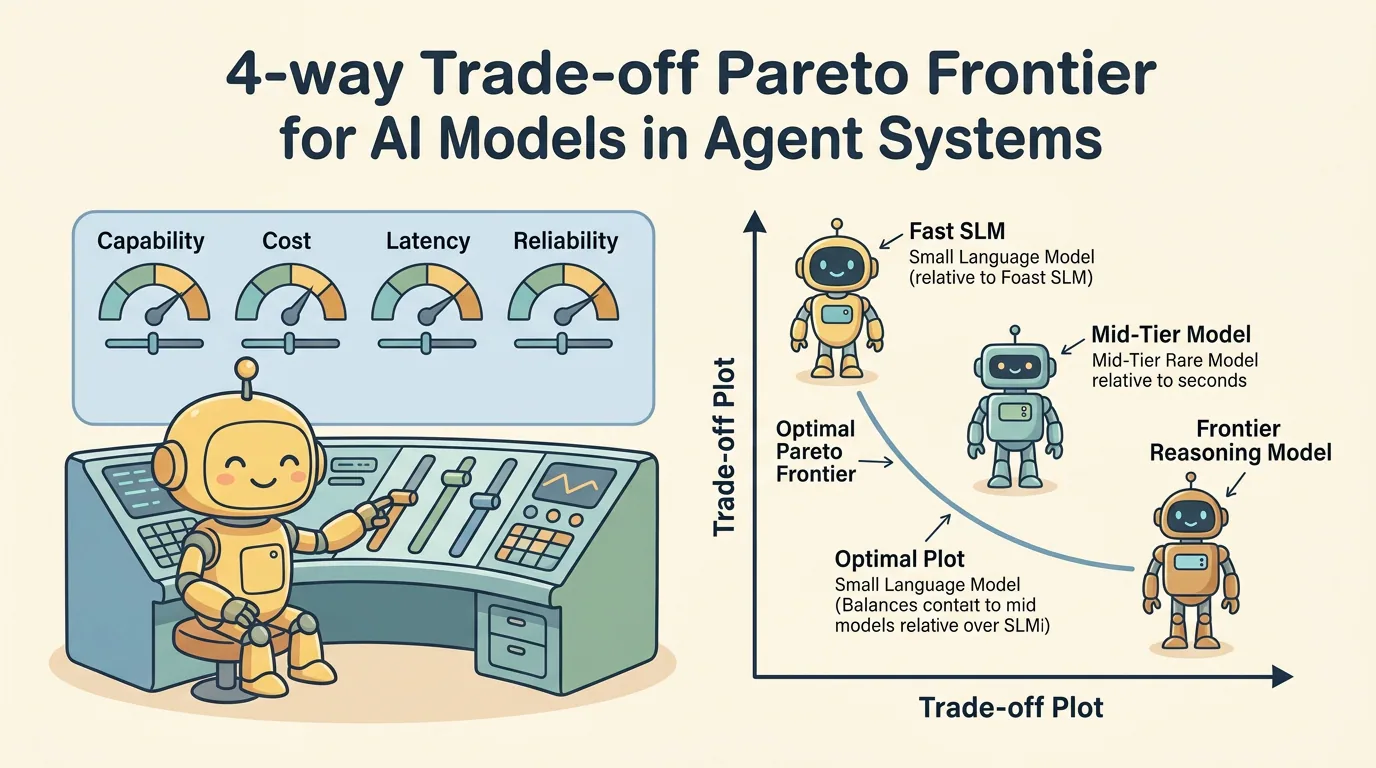
Figure 1. Capability, cost, latency, and reliability trade-off Pareto frontier. Production systems position distinct agent tasks along the optimal trade-off curve rather than defaulting all steps to high-cost frontier endpoints.
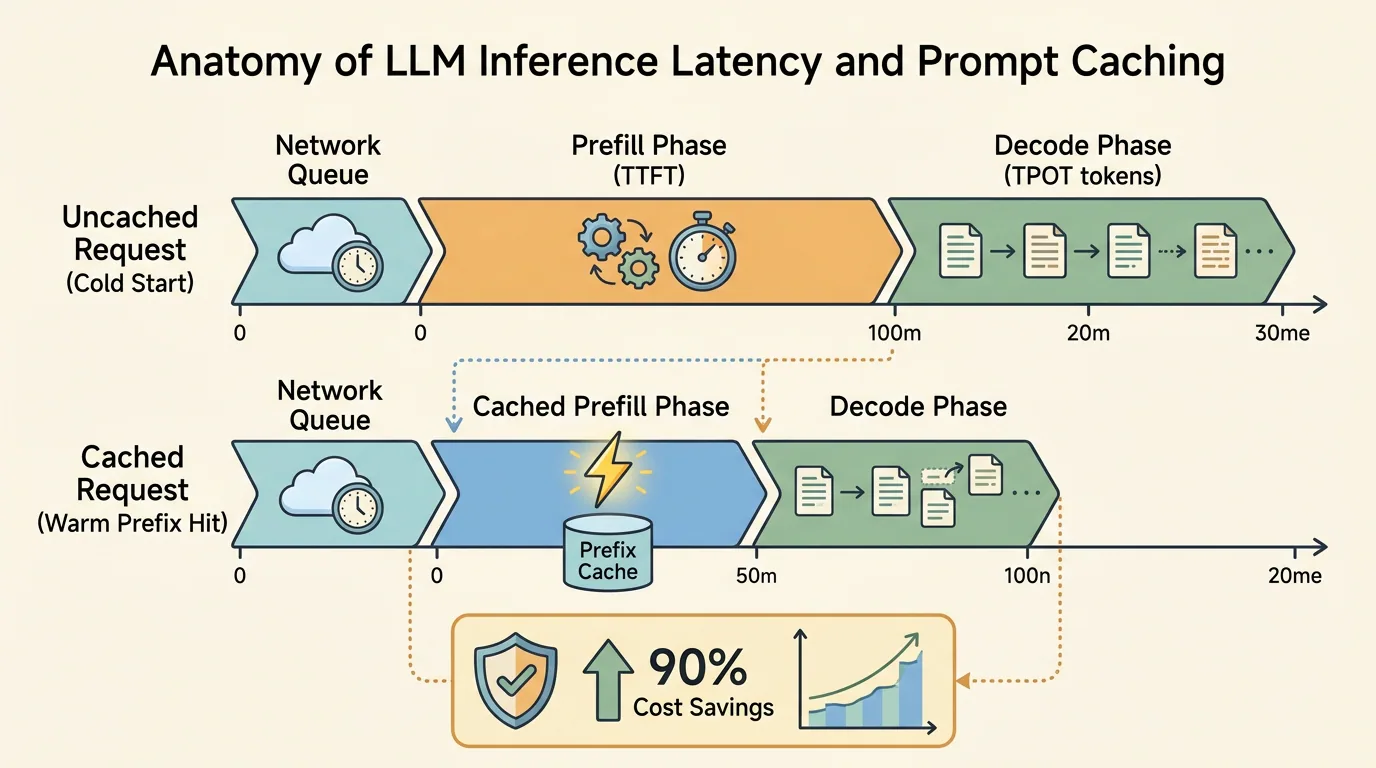
Figure 2. LLM inference latency anatomy and prompt caching acceleration. Prompt caching dramatically reduces the prefill phase (TTFT), while generation latency scales linearly with output token count.
As shown in Routing, cascades, and fallbacks, understanding these profiles enables gateways to dynamically match each subtask to its optimal execution tier.
How it works
Section titled “How it works”Optimizing model selection requires measuring four foundational dimensions:
1. Capability dimensions and evaluation
Section titled “1. Capability dimensions and evaluation”Model capability is not a monolithic score. In agentic workflows, capability breaks down into four operational axes:
- Multi-Step Reasoning Depth: The ability to formulate valid sequential plans, verify intermediate tool outputs, and recover from execution errors without hallucinating.
- Strict Structured Output Adherence: The capability to reliably emit valid JSON schemas matching requested Pydantic models or tool signatures without formatting syntax errors.
- Long-Context Retrieval Fidelity: Maintaining needle-in-a-haystack recall across 100k+ tokens without suffering “lost-in-the-middle” attention degradation.
- Instruction Hierarchy Robustness: Distinguishing system instructions from untrusted user data and retrieved third-party tool outputs.
2. Latency anatomy: TTFT vs TPOT
Section titled “2. Latency anatomy: TTFT vs TPOT”Total completion latency is governed by two distinct computational phases in modern transformer serving engines (Kwon et al., 2023): $$\text{Total Latency} = \text{Network Delay} + \text{Queue Delay} + \text{TTFT} + (N_{\text{output}} \times \text{TPOT})$$
- Time to First Token (TTFT): The duration from request dispatch until the model emits its first token. This corresponds to the prefill phase, where the model processes the entire prompt in parallel and builds the initial Key-Value (KV) cache. TTFT scales with prompt length ($N_{\text{input}}$).
- Time Per Output Token (TPOT): The duration required to generate each subsequent token during the auto-regressive decode phase. In decode, tokens are generated sequentially (memory-bandwidth bound). Typical cloud TPOT ranges from 10ms to 40ms per token.
- Streaming vs Non-Streaming: In interactive user interfaces, streaming output masks decode latency because human reading speed (~5 tokens/sec) is lower than model generation speed (~30-100 tokens/sec). However, in programmatic agent tool loops, the agent runtime cannot execute a tool call until the full JSON payload is completely generated and parsed.
3. Token economics and context caching
Section titled “3. Token economics and context caching”Inference costs are calculated per million tokens, with asymmetric pricing between input prompts, cached prompts, and output completions:
- Output Token Multiplier: Output tokens are typically 3x to 5x more expensive than uncached input tokens due to sequential GPU decode overhead and KV cache memory retention.
- Prompt Caching Economics: Modern providers (Anthropic, OpenAI, Google) allow prompt prefixes exceeding 1,024 tokens (such as static system instructions, API schemas, and few-shot examples) to be cached in GPU memory (Anthropic, 2024; OpenAI, 2024). Cache reads provide a 50% to 90% cost discount and reduce TTFT by up to 80%.
- Reasoning / Thinking Token Overhead: Frontier reasoning models generate hidden “chain-of-thought” tokens before outputting the final response. These internal tokens are billed as output tokens, often multiplying total per-turn costs by 3x to 10x.
4. Reliability, version pinning, and rate limits
Section titled “4. Reliability, version pinning, and rate limits”Operational stability depends on predictable execution environments:
- Snapshot Version Pinning: Production systems must reference specific immutable snapshot identifiers (e.g.,
gpt-4o-2024-08-06orclaude-3-5-sonnet-20241022) rather than floating alias pointers (e.g.,gpt-4oorclaude-3-5-sonnet-latest). Floating aliases introduce silent prompt drift, subtle behavioral changes, and unexpected tool signature parsing failures when providers deploy backend updates. - Rate Limit Throttling (RPM & TPM): Cloud providers enforce hard quotas on Requests Per Minute (RPM) and Tokens Per Minute (TPM). Multi-agent architectures with parallel tool workers can easily saturate TPM limits, triggering HTTP 429 errors.
- Deterministic Sampling Controls: Setting
temperature = 0.0or fixing aseedparameter reduces output variance. However, true bitwise determinism is rarely guaranteed across distributed cloud clusters due to non-associative floating-point addition in dynamic batching kernels.
Main variants
Section titled “Main variants”- Serverless Multi-Tenant Cloud APIs: Pay-per-token model with zero infrastructure management. Subject to multi-tenant noisy-neighbor latency jitter and global rate limits.
- Provisioned Throughput Units (PTUs): Reserved GPU capacity providing guaranteed TTFT/TPOT SLAs, zero HTTP 429 rate limits, and predictable monthly billing for high-volume enterprise agents.
- Self-Hosted Open Weights (vLLM / SGLang): Deploying open models (e.g., Llama 3, Qwen 2.5) on private GPU clusters. Eliminates third-party data sharing and rate limits while requiring dedicated infrastructure management and KV cache memory tuning (PagedAttention).
Minimal implementation
Section titled “Minimal implementation”The following implementation profiles inference latency, computes cached token savings, and tracks rate limit token consumption:
Expand minimal Python implementation
from dataclasses import dataclassimport timefrom typing import Dict, List, Tuple
@dataclass(frozen=True)class ModelProfile:    name: str    pinned_version: str    cost_per_m_input: float    cost_per_m_cached: float    cost_per_m_output: float    typical_ttft_ms: float    typical_tpot_ms: float
CATALOG = {    "frontier": ModelProfile("Frontier", "gpt-4o-2024-08-06", 2.50, 1.25, 10.00, 650.0, 25.0),    "slm": ModelProfile("SLM", "claude-3-5-haiku-20241022", 0.80, 0.08, 4.00, 180.0, 12.0),}
class InferenceProfiler:    """Profiles latency and cost with prompt cache accounting."""    @staticmethod    def evaluate(model_key: str, uncached_in: int, cached_in: int, out_tokens: int) -> Dict[str, float]:        m = CATALOG[model_key]        cost = (uncached_in * m.cost_per_m_input + cached_in * m.cost_per_m_cached + out_tokens * m.cost_per_m_output) / 1e6        is_cached = cached_in > 0        ttft = m.typical_ttft_ms * (0.25 if is_cached else 1.0)        generation_time = out_tokens * m.typical_tpot_ms        return {            "total_cost_usd": round(cost, 6),            "ttft_ms": round(ttft, 2),            "total_latency_ms": round(ttft + generation_time, 2),        }
Framework implementations
Section titled “Framework implementations”- OpenAI API & SDK: Native support for prompt caching (automatic on prefixes >1024 tokens), structured outputs with strict JSON schemas, and snapshot version pinning.
- Anthropic Claude API: Explicit prompt cache control blocks (
cache_control={"type": "ephemeral"}), high-speed Haiku endpoints, and detailed cache-read/cache-creation token usage metrics. - vLLM Inference Server: Industry-standard open-source engine implementing PagedAttention, chunked prefill, and prefix caching for self-hosted models.
- LiteLLM: Unified proxy that standardizes pricing calculations, tracks organization-wide spend budgets, and enforces token-rate quotas across 100+ providers.
Data flow and state changes
Section titled “Data flow and state changes”Trace the lifecycle of a prompt processed by a cached model gateway:
| Step | Gateway Subsystem | State / Event | Computational Action | Telemetry Metric Recorded |
|---|---|---|---|---|
| 1 | Ingress & Quota Check | EVALUATING_BUDGET |
Verify client TPM and RPM limits | rate_limit_headroom = 42% |
| 2 | Prompt Prefix Hashing | CACHE_LOOKUP |
Compute hash of static system prompt and tools | cache_hit = TRUE (8,000 tokens) |
| 3 | Prefill (Prefill Engine) | PREFILL_ACTIVE |
Reuse cached KV tensor; process only fresh delta | ttft_ms = 145 ms (saved 78%) |
| 4 | Decode (Decode Engine) | DECODE_ACTIVE |
Auto-regressively generate structured tool call | tpot_ms = 22.4 ms / token |
| 5 | Accounting & Egress | COMPLETED |
Deduct discounted token fees and return response | cost_usd = $0.00312 |
Trust boundaries
Section titled “Trust boundaries”- Version Drift & Behavioral Contract Boundary: Upstream model updates can subtly alter tool calling syntax or reasoning behavior. Pinning immutable model snapshot versions maintains the validation and testing boundary.
- Multi-Tenant Latency Jitter Boundary: In shared public cloud infrastructure, sudden traffic surges from unrelated tenants can cause TTFT spikes (noisy neighbor effect). Mission-critical agent loops require latency timeouts and fallback routes.
- Financial Budget & Spend Exhaustion Boundary: Autonomous loops running in unbounded recursion can rapidly consume thousands of dollars in token fees. Strict per-session token budget limiters must enforce execution cutoffs.
Reliability failures
Section titled “Reliability failures”- Floating Alias Drift: Pointing production agents to
gpt-4orather thangpt-4o-2024-08-06. A silent provider backend model update causes the model to omit mandatory JSON keys, breaking downstream code execution. - Context Degradation (Lost in the Middle): Packing 150,000 tokens into a model’s context window. Although the context window accommodates the tokens, the model fails to retrieve key constraints located in the middle 50% of the prompt.
- Thundering Herd Rate Limit Cascades: When five parallel agent workers simultaneously retry failed requests without jitter, the synchronized burst immediately triggers HTTP 429 rate limit lockouts across the entire API key.
Worked example
Section titled “Worked example”Consider an enterprise customer support triage agent handling 50,000 inquiries per day:
- Baseline (Pure Frontier Uncached): Every query dispatches to a frontier model with 6,000 tokens of system instructions and context. Cost: $0.025 per request $\times$ 50,000 = $1,250/day ($37,500/month). Average latency: 4.8 seconds.
- Optimized Tiered Architecture:
- System prompt (5,500 tokens) is structured with prompt cache headers (cache hit rate: 94%).
- Router directs 80% of standard FAQ inquiries to a fast SLM ($0.80/M input).
- Escalates remaining 20% complex account disputes to a pinned frontier model.
- Outcome: Daily inference cost drops to $142/day ($4,260/month, an 88.6% cost reduction), while average end-to-end response latency drops from 4.8s to 1.1s.
Limitations and trade-offs
Section titled “Limitations and trade-offs”- Cache Invalidation vs Dynamic Context: Dynamic system prompts (e.g., injecting current timestamps or changing user IDs at the start of the prompt) invalidate the prompt cache prefix, destroying caching cost benefits.
- Strict Determinism Limitations: Even with
temperature = 0.0, floating-point arithmetic across dynamic GPU batches can occasionally produce nondeterministic token selections. Critical validation must occur at the software gate rather than relying solely on model-level determinism.
Security preview
Section titled “Security preview”Inference economics and reliability mechanisms introduce direct security implications:
- Denial-of-Wallet (Resource Exhaustion): Attackers craft recursive prompts designed to force models into emitting maximum reasoning tokens or invalidating cache prefixes, multiplying organizational cloud spend.
- Model Downgrade Attacks: Adversaries manipulate routing classifications to force high-risk authentication decisions into weaker SLMs lacking hardened safety filters.
- Cache Side-Channel Probing: Variations in TTFT can potentially reveal whether another tenant or user recently processed similar confidential documents through shared prefix caches.
We examine denial-of-wallet defenses, model abuse controls, and side-channel risks in Instructions, context, and model security.
Open research questions
Section titled “Open research questions”- How can serving engines dynamically schedule multi-agent KV caches to maximize cross-agent prefix sharing without introducing cross-tenant side channels?
- What formal verification metrics can reliably quantify long-context degradation before deploying agents to production?
Key takeaways
Section titled “Key takeaways”- Inference latency consists of prefill (TTFT, parallel prompt processing) and decode (TPOT, auto-regressive sequential generation).
- Prompt caching provides up to 90% cost savings and 80% TTFT reduction by keeping static prompt prefixes warm in GPU memory.
- Model version pinning using exact snapshot identifiers prevents silent model drift and breaking changes in production tool schemas.
- Effective agent architectures balance capability, cost, latency, and reliability by matching specific subtasks to optimal model tiers on the Pareto frontier.
References
Section titled “References”- Kwon, W., Li, Z., Zhuang, S., Sheng, Y., Zheng, L., Yu, C. H., Gonzalez, J. E., Zhang, H., & Stoica, I. Efficient Memory Management for Large Language Model Serving with PagedAttention. Proceedings of the 29th ACM Symposium on Operating Systems Principles (SOSP), 2023. DOI: 10.1145/3600006.3613165.
- OpenAI. Latency Optimization, Prompt Caching, and Model Version Pinning Guide. OpenAI Platform Documentation, 2024. OpenAI Platform.
- Anthropic. Prompt Caching and Operational Resilience in Claude API. Anthropic Claude Documentation, 2024. Anthropic Docs.