
Termination, cancellation, and cleanup
Explains immutable terminal states, cooperative cancellation token propagation, compensating rollback sagas, and deterministic resource cleanup in agent runtimes.
- Differentiate between transient suspended states and immutable terminal states.
- Propagate cancellation tokens hierarchically to halt child subagents and in-flight model streams.
- Implement the Saga pattern with compensating actions to roll back partial side effects upon workflow failure.
- Enforce deterministic resource finalization to prevent leaked database leases, sockets, and orphaned sandbox directories.
Why this matters
Section titled “Why this matters”Autonomous agents execute multi-step workflows that provision cloud resources, make database changes, and invoke external APIs. However, not every agent run finishes cleanly according to plan. Users cancel long-running tasks, supervisor timeouts expire, and downstream microservices fail midway through a multi-step operation.
If an agent runtime lacks structured termination and cleanup protocols, failed or cancelled runs leave behind orphaned resources, such as running virtual machines, dangling database locks, unreleased temporary files, and partially completed financial transactions. Termination, cancellation, and cleanup mechanisms ensure that when an agent run stops, whether by success, user abort, or unrecoverable error, the system transitions into an immutable terminal state and leaves the environment in a clean, consistent state (Microsoft, 2024; Temporal Technologies, 2024; LangChain, 2024; Garcia-Molina & Salem, 1987).
Simple mental model
Section titled “Simple mental model”Think of an automated flight and hotel booking service:
- The forward workflow: the agent reserves a flight ticket, reserves a rental car, and attempts to book a hotel room.
- The unexpected failure: the hotel API rejects the reservation because no rooms remain available.
- The compensating rollback (the Saga): rather than leaving the user with an isolated flight ticket and rental car, the system automatically triggers compensating actions in reverse order: it cancels the rental car reservation and refunds the flight ticket.
- The cancellation signal: if the user presses “Cancel Booking” while the agent is searching, the system immediately halts background search queries and releases temporary hold holds.
- Final cleanup: the booking session is sealed as
CANCELLED, temporary payment tokens are wiped, and zero orphaned charges remain.
These mechanisms guarantee that operations either complete fully or roll back safely without leaving partial, inconsistent side effects.
Position in the agent workflow
Section titled “Position in the agent workflow”Termination and cleanup sit at the exit boundary of the agent lifecycle. Regardless of whether an agent finishes through natural goal satisfaction, explicit user cancellation, policy rejection, or hard execution timeout, the runtime intercepts the exit transition.
The finalizer executes compensating actions for any partially completed subtasks, closes network descriptors and temporary sandbox folders, persists the terminal status in the checkpointer database, and flushes audit logs.
How it works
Section titled “How it works”Structured termination and resource cleanup operate across four core mechanisms:
1. Terminal states versus transient states
Section titled “1. Terminal states versus transient states”Runtimes enforce a strict boundary between transient states (which can be resumed) and terminal states (which are immutable):
- Transient states:
QUEUED,IN_PROGRESS,REQUIRES_ACTION, andRETRY_BACKOFF. These states hold active leases and can transition to other states. - Terminal states:
COMPLETED(goal satisfied),CANCELLED(user or supervisor abort),FAILED_FATAL(unrecoverable error), andTIMEOUT(execution budget exhausted). Once a run enters a terminal state, it can never be restarted or modified; new work requires instantiating a separate run.
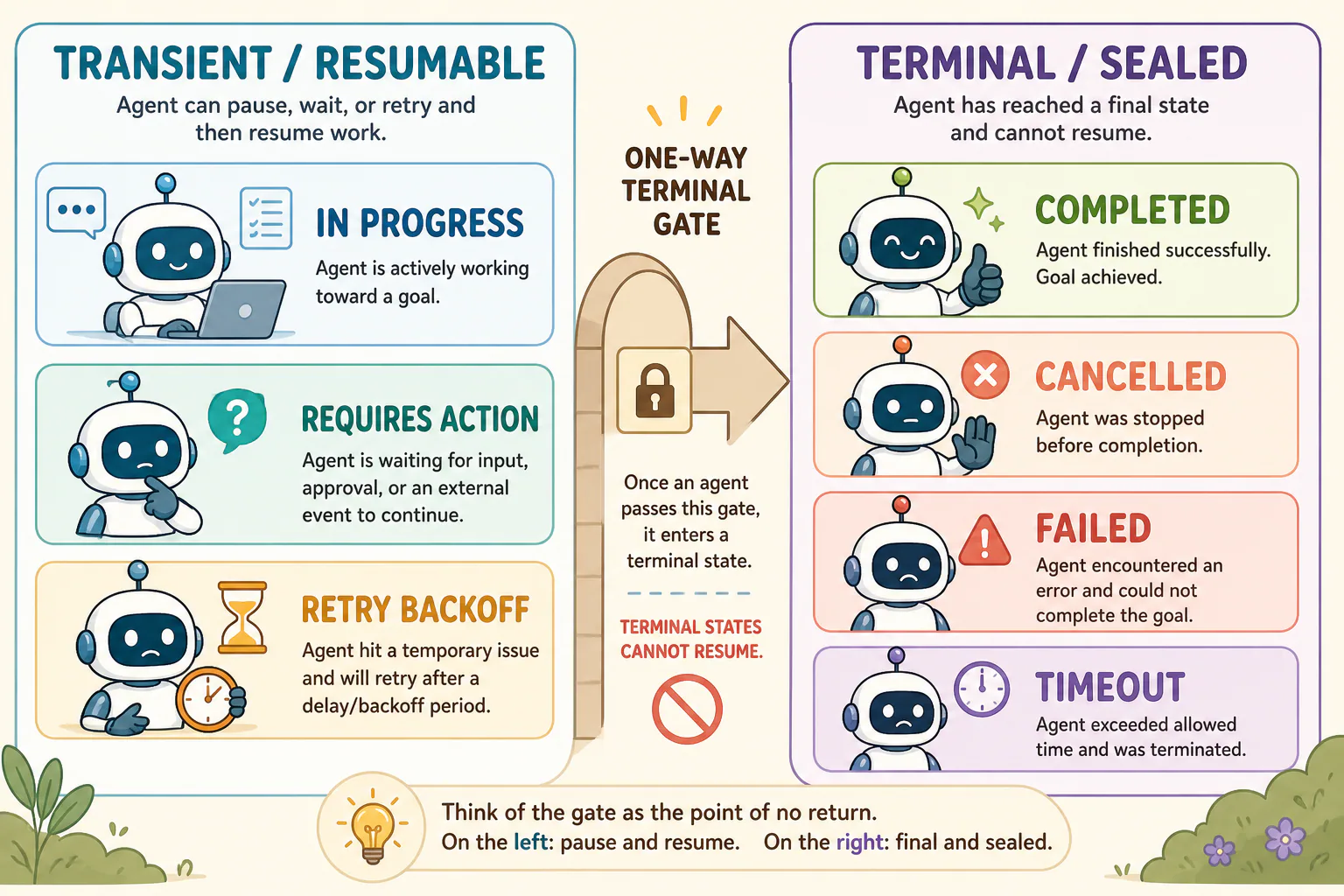
Figure 1. State classification. A transient state can resume or change, while a terminal state is sealed and requires a new run for new work.
2. Hierarchical cancellation token propagation
Section titled “2. Hierarchical cancellation token propagation”When a user or supervisor aborts an active run, the runtime emits an Abort Signal / Cancellation Token (Temporal Technologies, 2024; LangChain, 2024). The signal propagates hierarchically:
- The parent run sets its cancellation flag.
- In-flight LLM token streaming connections are closed immediately to halt token billing.
- Cancellation signals are delivered to all active child subagents and background worker tasks.
- Active tool workers detect the cancellation token cooperatively and abort long-running computations.
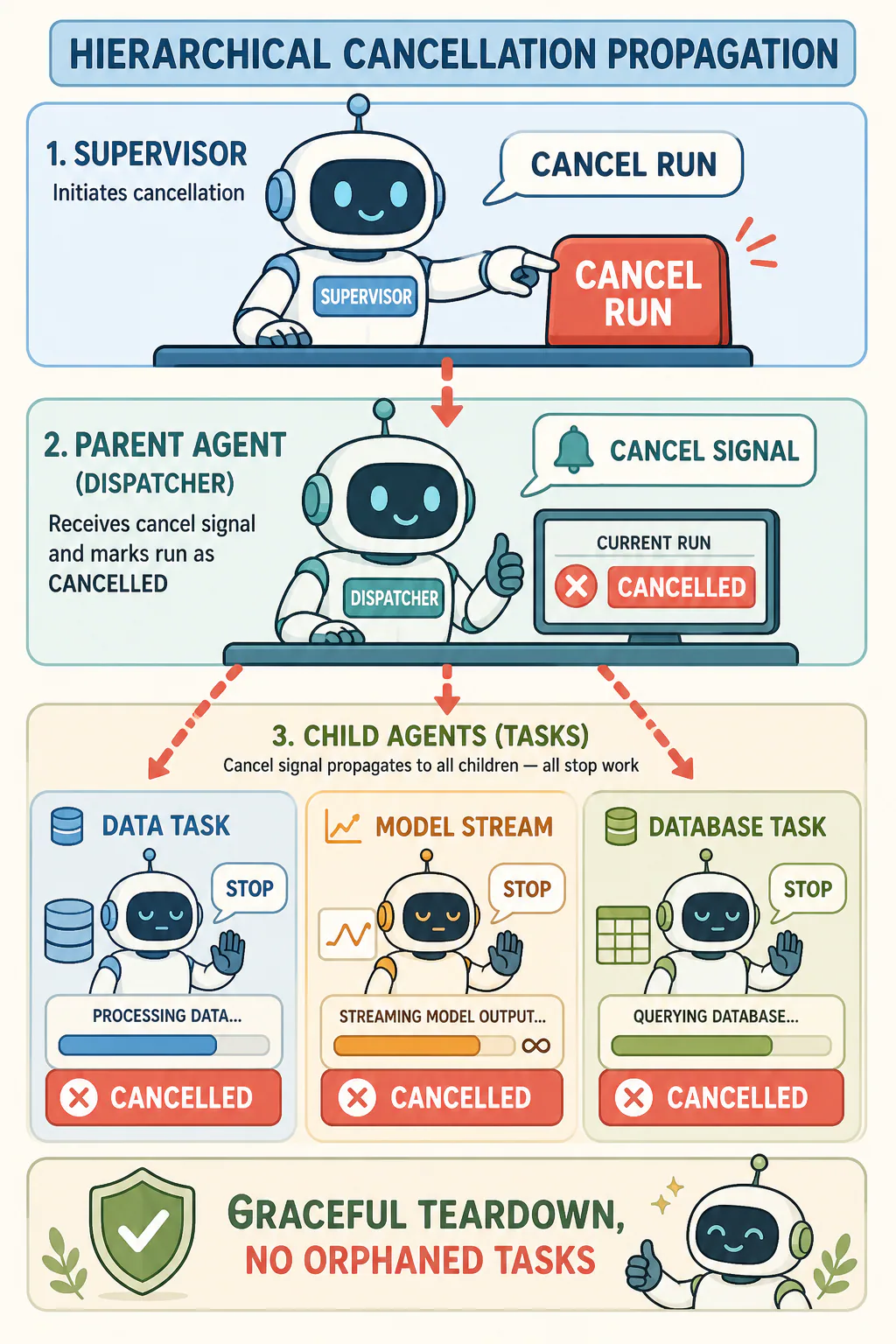
Figure 2. Cancellation propagation. The same cancellation signal reaches every active child task so that no orphaned work continues after a run is aborted.
3. The Saga pattern and compensating actions
Section titled “3. The Saga pattern and compensating actions”When a multi-step workflow fails midway through execution, traditional database ACID rollbacks are impossible because external tools and microservices have already executed real-world side effects. Agent runtimes apply the Saga Pattern (Garcia-Molina & Salem, 1987; Temporal Technologies, 2024):
- Every forward tool action $F_i$ is paired with a corresponding backward compensating action $C_i$ (such as
provision_vmpaired withdelete_vm). - If step $k$ fails, the runtime pauses forward execution and invokes compensating actions for all previously completed steps in reverse order:
$$ ext{Rollback Sequence} = [C_{k-1}, C_{k-2}, …, C_1]$$
Compensating actions restore the external environment to a consistent baseline state.
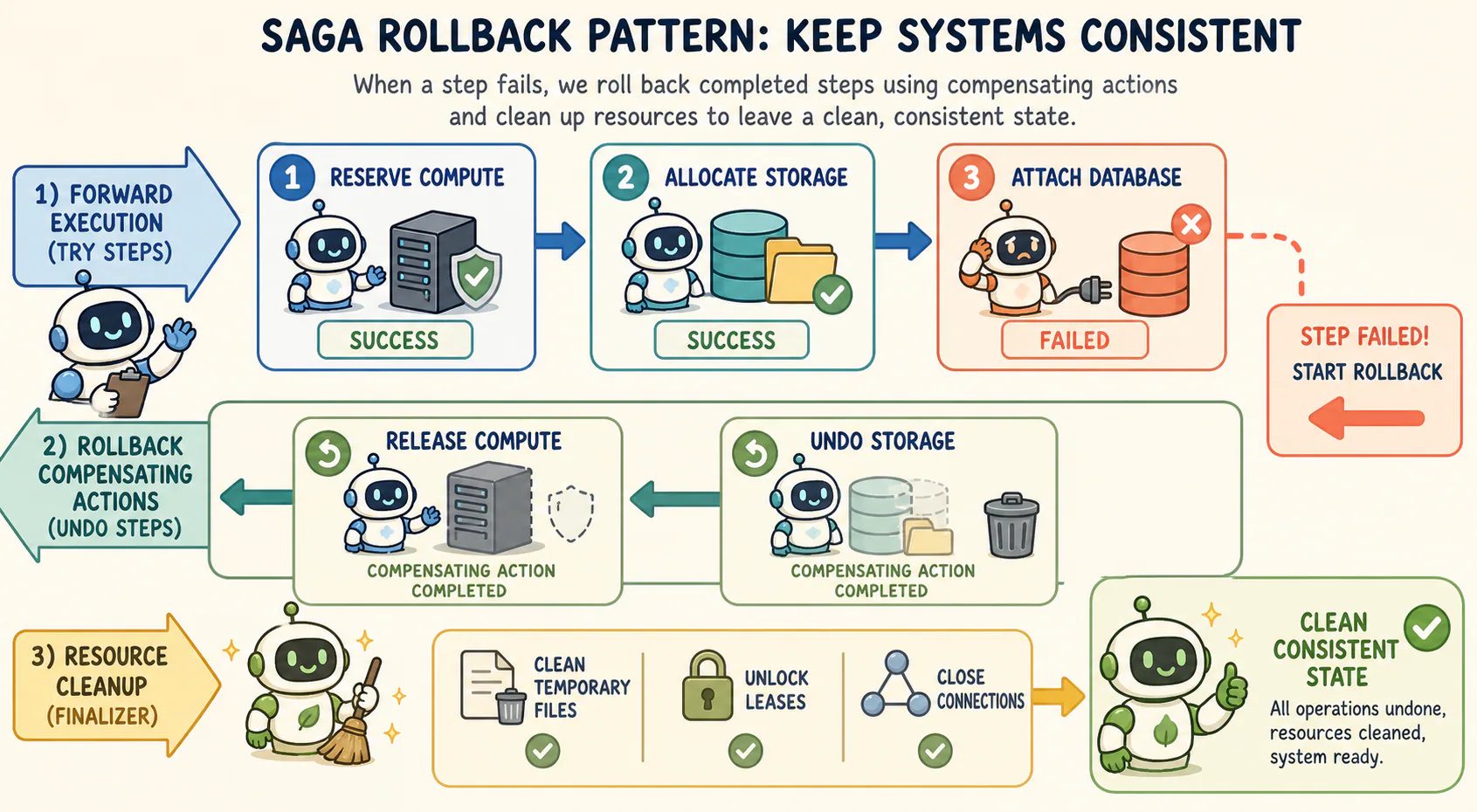
Figure 3. Saga compensation. After a later action fails, the runtime reverses earlier completed actions in the opposite order before finalizing resources.
4. Deterministic resource finalization
Section titled “4. Deterministic resource finalization”Upon reaching any terminal state, a dedicated finalizer routine runs guaranteed cleanup handlers:
- Releases distributed locks and thread leases in Redis or Consul.
- Deletes temporary working directories, scratch files, and sandbox containers.
- Closes database connection pools and open socket descriptors.
- Emits terminal audit records and telemetry metrics.
Main variants
Section titled “Main variants”- Rule-Based Termination (AutoGen): Multi-agent conversations define explicit termination conditions (such as detecting
TERMINATEstrings, reaching max consecutive turns, or evaluating custom boolean predicates) (Microsoft, 2024). - Temporal Cancellation Scopes: Workflows wrap subtasks in nested cancellation scopes that automatically invoke cleanup handlers upon receiving external cancellation signals (Temporal Technologies, 2024).
- LangGraph Finalizers and Rollback Channels: Graph workflows define cleanup nodes connected to error edges, ensuring state teardown occurs before graph exit (LangChain, 2024).
Minimal implementation
Section titled “Minimal implementation”The following Python snippet demonstrates cooperative cancellation token checking and Saga compensating action rollback. The full runnable example demonstrates VM reservation, storage provisioning, database attachment failure, and clean backward compensation.
Expand minimal Python implementation
from dataclasses import dataclassfrom enum import Enum, autofrom typing import Callable, List, Tuple
class TerminalState(Enum):    COMPLETED = auto()    CANCELLED = auto()    FAILED_COMPENSATED = auto()
@dataclassclass SagaStep:    name: str    forward: Callable[[], bool]    compensate: Callable[[], bool]
class SagaManager:    def __init__(self):        self.completed = []
    def run(self, steps: List[SagaStep], is_cancelled: bool) -> Tuple[TerminalState, List[str]]:        log = []        for step in steps:            if is_cancelled:                self.rollback(log)                return TerminalState.CANCELLED, log
            if step.forward():                self.completed.append(step)                log.append(f"Step {step.name} passed")            else:                log.append(f"Step {step.name} failed; rolling back")                self.rollback(log)                return TerminalState.FAILED_COMPENSATED, log
        return TerminalState.COMPLETED, log
    def rollback(self, log: List[str]):        while self.completed:            step = self.completed.pop()            step.compensate()            log.append(f"Compensated {step.name}")
Run cancellation_sagas_cleanup.py to inspect the complete forward execution trace, failure detection, and compensating rollback execution.
Data flow and state changes
Section titled “Data flow and state changes”- Execution dispatch: The agent executes forward steps, registering each completed step in the saga stack.
- Interrupt or failure event: An in-flight step returns a fatal error or the client issues an abort signal.
- Cancellation propagation: The runtime interrupts active child workers and stops token generation.
- Compensation loop: The runtime pops completed steps from the stack and executes their compensating actions in LIFO order.
- State finalization: The runtime commits the terminal status (
FAILED_COMPENSATEDorCANCELLED) to the checkpointer. - Resource teardown: All temporary storage, leases, and connections are released.
Trust boundaries
Section titled “Trust boundaries”- Cancellation authority: Cancellation endpoints must authenticate callers to ensure that malicious actors cannot spoof cancellation signals to abort critical system workflows.
- Compensation isolation: Compensating actions must execute with verified credentials and isolated execution bounds so that a failed rollback does not escalate into wider system corruption.
- Terminal state immutability: Checkpointer storage must enforce read-only immutability on terminal records to prevent unauthorized reopening or tampering with concluded runs.
Reliability failures
Section titled “Reliability failures”- Dangling child tasks: If cancellation tokens are not passed cooperatively to child processes, orphaned background tasks continue running and wasting compute.
- Partial compensation failure: If a compensating action itself fails (for example, due to network drop during cloud volume deletion), the system enters an inconsistent partial state requiring manual administrator intervention.
- Resource leak on crash: If a host server crashes during finalization before cleanup handlers execute, persistent leases can remain locked until lease TTL expiration.
Limitations and trade-offs
Section titled “Limitations and trade-offs”- Compensation complexity: Writing and testing reliable compensating actions for every forward tool call adds substantial development and verification effort.
- Non-compensable side effects: Certain real-world actions (such as sending an SMS or publishing an email) cannot be undone; they can only be mitigated with follow-up apology notices.
- Teardown latency: Executing multi-step compensating rollbacks adds latency before a failed run can return its final response.
Security preview
Section titled “Security preview”In Pass 2, termination and cleanup architectures are evaluated against Denial of Service via Forged Cancellation, Orphaned Resource Exploitation, and Incomplete Rollback Tampering. Attackers exploit partial rollbacks to leave vulnerable intermediate accounts open or flood cancellation endpoints to terminate security audits. We examine cryptographically verified abort signals, idempotent compensation verification, and automated lease reclamation in Instructions, context, and model security.
Open research questions
Section titled “Open research questions”- How can LLMs autonomously generate verified, safe compensating action scripts when interacting with novel or unversioned third-party APIs?
- What consensus protocols can guarantee complete saga rollback across decentralized multi-agent organizations with zero shared infrastructure?
Key takeaways
Section titled “Key takeaways”- Terminal states (
COMPLETED,CANCELLED,FAILED,TIMEOUT) are immutable and guarantee that runs cannot be corrupted after conclusion. - Cancellation tokens propagate hierarchically down agent trees to halt child subagents, network calls, and token generation immediately.
- The Saga pattern pairs every forward tool invocation with a backward compensating action to roll back partial side effects upon failure.
- Deterministic cleanup handlers guarantee that distributed locks, database connections, and temporary sandboxes are released safely.
References
Section titled “References”- Microsoft Research. AutoGen: Termination Conditions, Stop Signals, and Cleanup. AutoGen Documentation, 2024. AutoGen Termination.
- Temporal Technologies. Workflow Cancellation, Scope Cleanup, and Compensating Actions. Temporal Documentation, 2024. Temporal Cancellation.
- LangChain Community. Managing Cancellation, Timeouts, and Cleanup in LangGraph. LangGraph Documentation, 2024. LangGraph Cancellation.
- Garcia-Molina, H., & Salem, K. Sagas. ACM SIGMOD International Conference on Management of Data, 1987. ACM Digital Library.