
Consolidation, forgetting, and evaluation
Explores how autonomous agents synthesize episodic memories into higher-level semantic insights, prune obsolete or decaying records, and evaluate memory performance.
- Design background reflection and consolidation pipelines to synthesize raw episodic events into structured semantic knowledge trees.
- Implement principled forgetting and eviction mechanisms using time-decay functions, TTL expiration, and contradiction resolution.
- Enforce right-to-be-forgotten privacy compliance across vector indexes and persistent relational databases.
- Measure long-term memory effectiveness using quantitative benchmarks including Recall@K, contradiction rate, reflection fidelity, and query latency.
Why this matters
Section titled “Why this matters”As autonomous agents operate over extended time horizons, their persistent storage accumulates thousands of granular, timestamped interaction logs. If an agent simply appends every new event to a raw database without maintenance, memory quality rapidly degrades. The system suffers from three core compounding problems: knowledge fragmentation, catastrophic contradiction, and unbounded storage bloat.
Without memory consolidation, an agent treats twenty separate conversations about Python type errors as isolated incidents rather than generalizing them into a coherent understanding of user preferences (Park et al., 2023). Without systematic forgetting, obsolete decisions remain in storage, causing the agent to act on conflicting instructions. Finally, without rigorous evaluation, developers cannot detect whether memory updates actually improve task performance or quietly introduce subtle hallucinations (Packer et al., 2023; Zhong et al., 2024).
Mastering consolidation, pruning, and evaluation allows engineering teams to build self-maintaining memory subsystems that stay accurate, compact, and aligned with user goals over months of continuous production operation.
Simple mental model
Section titled “Simple mental model”Think of an apprentice scientist keeping a laboratory research notebook:
- Daily raw observations (episodic stream): Detailed, messy notes recorded every hour (“At 2 PM, heated mixture to 80C; slight discoloration observed”).
- Weekly synthesis and summary reviews (reflection and consolidation): Every Friday, the scientist reviews thirty pages of notes and writes a single clean conclusion: “Reagent B degrades above 75C; adjust reaction temperature to 70C for future experiments.”
- Disposal of obsolete drafts (forgetting and pruning): Outdated initial hypotheses and temporary scratch calculations are archived or shredded to keep the lab bench organized and avoid testing disproven formulas.
- Independent peer review and replication tests (evaluation benchmarks): A senior researcher periodically tests the scientist by asking complex problem-solving questions to verify that the distilled conclusions are accurate and quickly accessible.
If the scientist never distilled the raw notes, they would spend hours searching through dozens of notebooks for a single temperature limit.
Position in the agent workflow
Section titled “Position in the agent workflow”Consolidation, forgetting, and evaluation operate as background asynchronous control loops alongside real-time agent execution. While the runtime serves user queries and updates short-term working memory, background workers continuously maintain persistent stores.
During idle periods or scheduled maintenance windows, the consolidation engine clusters recent episodic traces, generates high-level reflections, and updates the semantic knowledge base. Concurrently, the pruning manager evaluates time-decay curves, evicts expired items, and resolves detected contradictions. The evaluation framework runs automated benchmark suites against memory checkpoints to ensure retrieval accuracy and temporal stability before deploying updates.
How it works
Section titled “How it works”A production memory lifecycle relies on four foundational systems: reflection consolidation pipelines, mathematical forgetting models, contradiction resolution, and quantitative evaluation benchmarks.
1. The reflection and consolidation pipeline
Section titled “1. The reflection and consolidation pipeline”Raw interaction logs contain excessive noise and specific circumstantial details. The reflection mechanism transforms concrete episodic observations into generalized semantic insights through a three-level hierarchy (Park et al., 2023):
- Level 0 (Raw episodic records): Individual timestamped actions and user exchanges (e.g., “User requested adding retry logic to S3 downloader”, “User asked to catch socket timeouts”).
- Level 1 (Synthesis question generation): A background evaluation agent inspects recent high-salience episodic records and prompts an LLM with synthesis questions: “What high-level architectural patterns or recurring user preferences emerge from these recent events?”
- Level 2 (Abstract semantic insights): The model synthesizes answers into concise rules and profiles (e.g., “User prefers resilient network operations with exponential backoff”), indexing them with direct provenance pointers to the underlying Level 0 records.
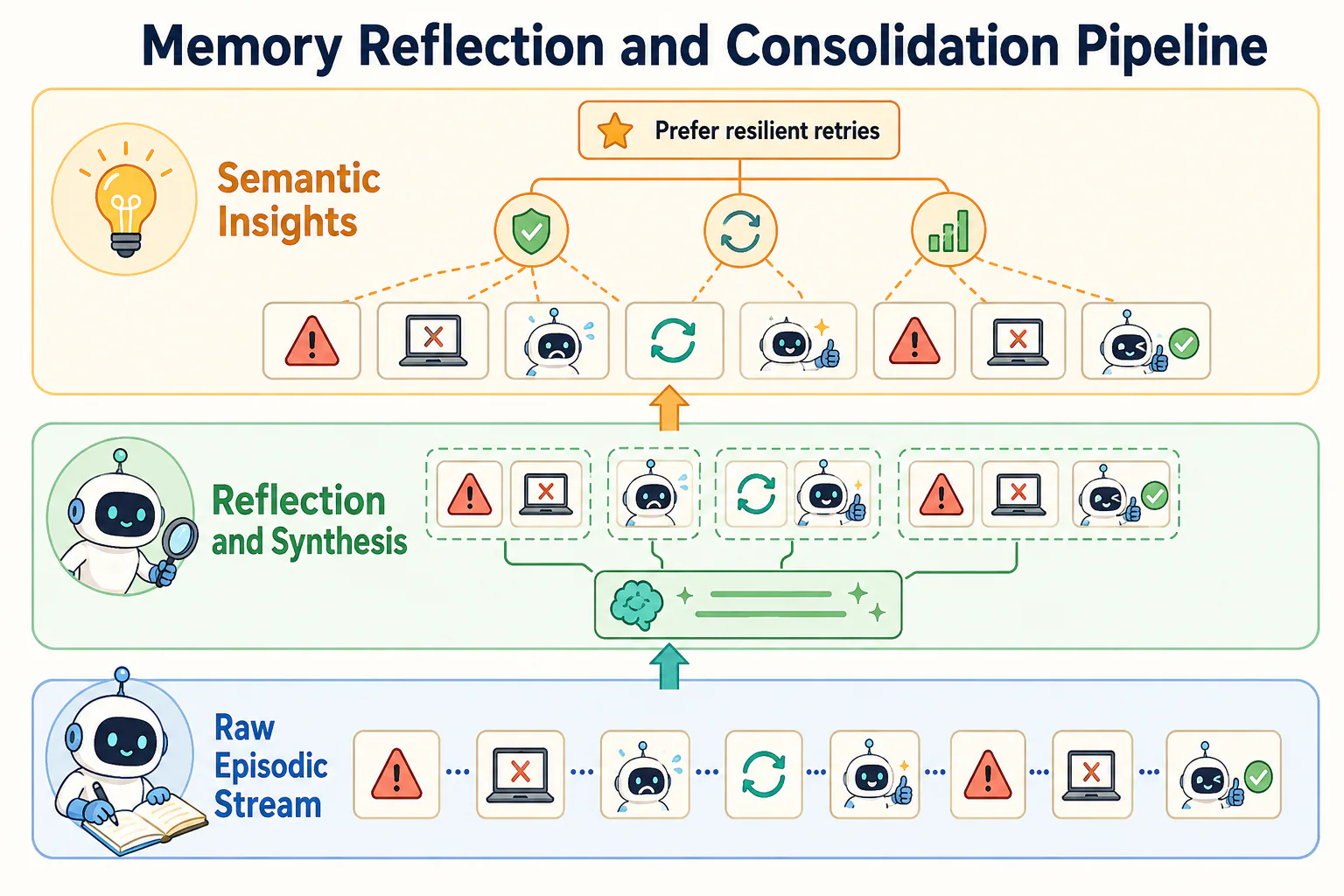
Figure 1. Memory reflection and consolidation pipeline. An asynchronous reflection engine queries concrete episodic events to synthesize high-level semantic rules.
2. Principled forgetting and pruning mechanisms
Section titled “2. Principled forgetting and pruning mechanisms”An agent memory store cannot grow indefinitely. Sustainable memory architectures apply four distinct pruning mechanisms (Packer et al., 2023; Zhong et al., 2024):
- Time-decay eviction (Ebbinghaus forgetting curve): Memory retention strength decays as a function of idle time since last access ($\Delta t$):
$$R(t) = S \cdot e^{-\frac{\Delta t}{\tau}}$$
where $S$ is the initial salience score, $\Delta t$ is elapsed time, and $\tau$ is the memory stability half-life parameter. When $R(t)$ drops below a configured retention threshold, low-value episodic details are evicted.
- Time-to-Live (TTL) expiration: Short-lived tokens, intermediate tool outputs, and ephemeral working buffers are tagged with strict expiration timestamps and purged by automated sweeping jobs.
- Contradiction reconciliation: When a newly observed fact directly conflicts with an existing memory record, the memory manager deprecates the older record, updates the current active belief, and logs an audit delta.
- Right-to-be-forgotten deletion: When a user or tenant requests data removal, the system executes atomic hard deletions across primary document stores, relational databases, and vector search indices.
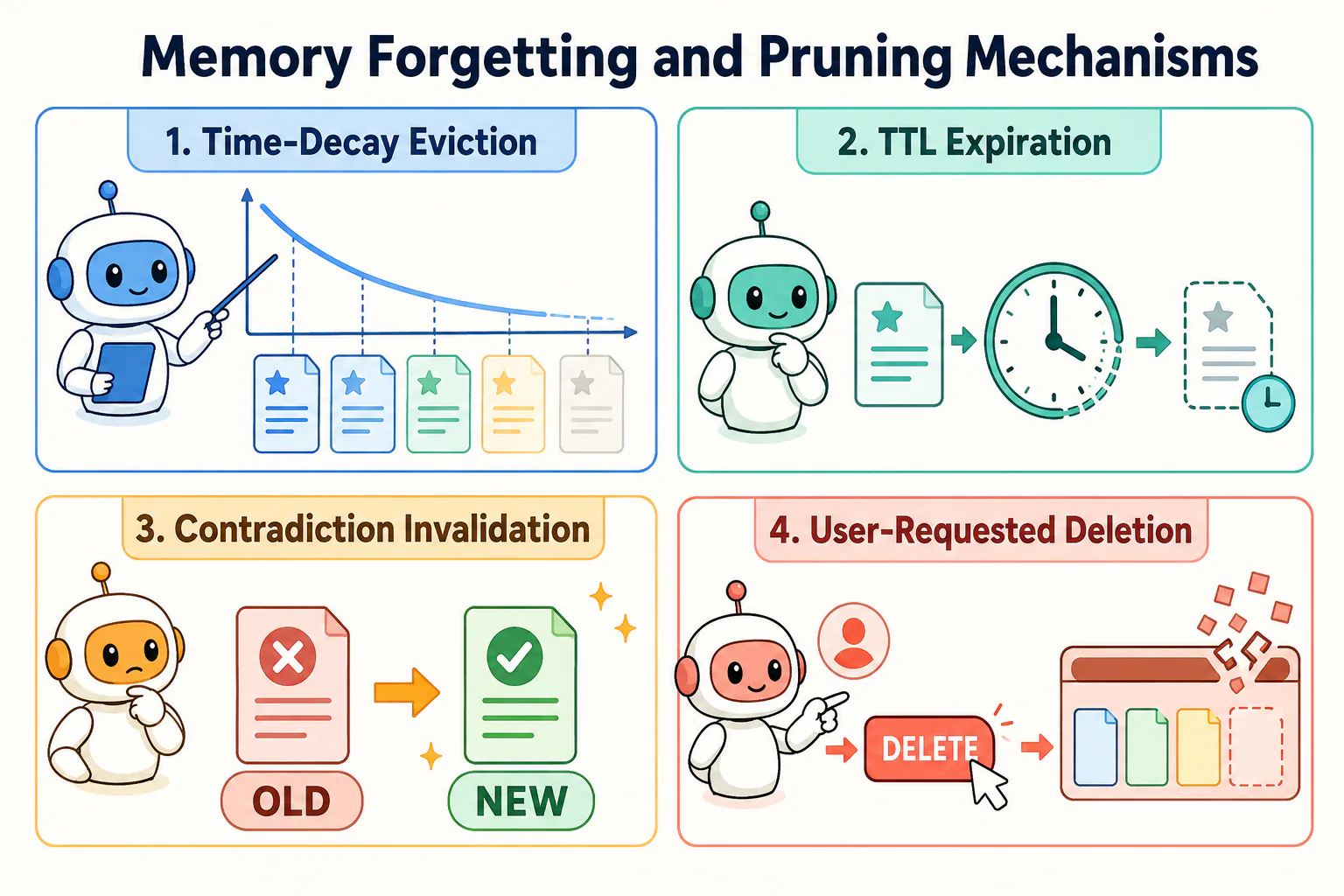
Figure 2. Memory forgetting and pruning mechanisms. Four distinct retention strategies prevent unbounded storage growth and resolve factual contradictions.
3. Quantitative memory evaluation metrics
Section titled “3. Quantitative memory evaluation metrics”Evaluating agent memory requires moving beyond manual observation to automated, reproducible benchmarks (Packer et al., 2023; Zhong et al., 2024):
| Metric | Target | Description |
|---|---|---|
| Retrieval Recall@K | $> 90%$ | Proportion of test cases where the relevant historical fact is present in the top-$K$ recalled items |
| Contradiction Rate | $< 1%$ | Frequency of retrieved contexts containing mutually contradictory statements |
| Reflection Fidelity | $> 95%$ | Accuracy of synthesized semantic insights when evaluated against ground truth episodic logs |
| Query Latency (P99) | $< 50\text{ ms}$ | Time required to perform namespaced vector search, decay computation, and reranking |
| Storage Footprint | Bounded | Total token and byte consumption per active user profile over time |
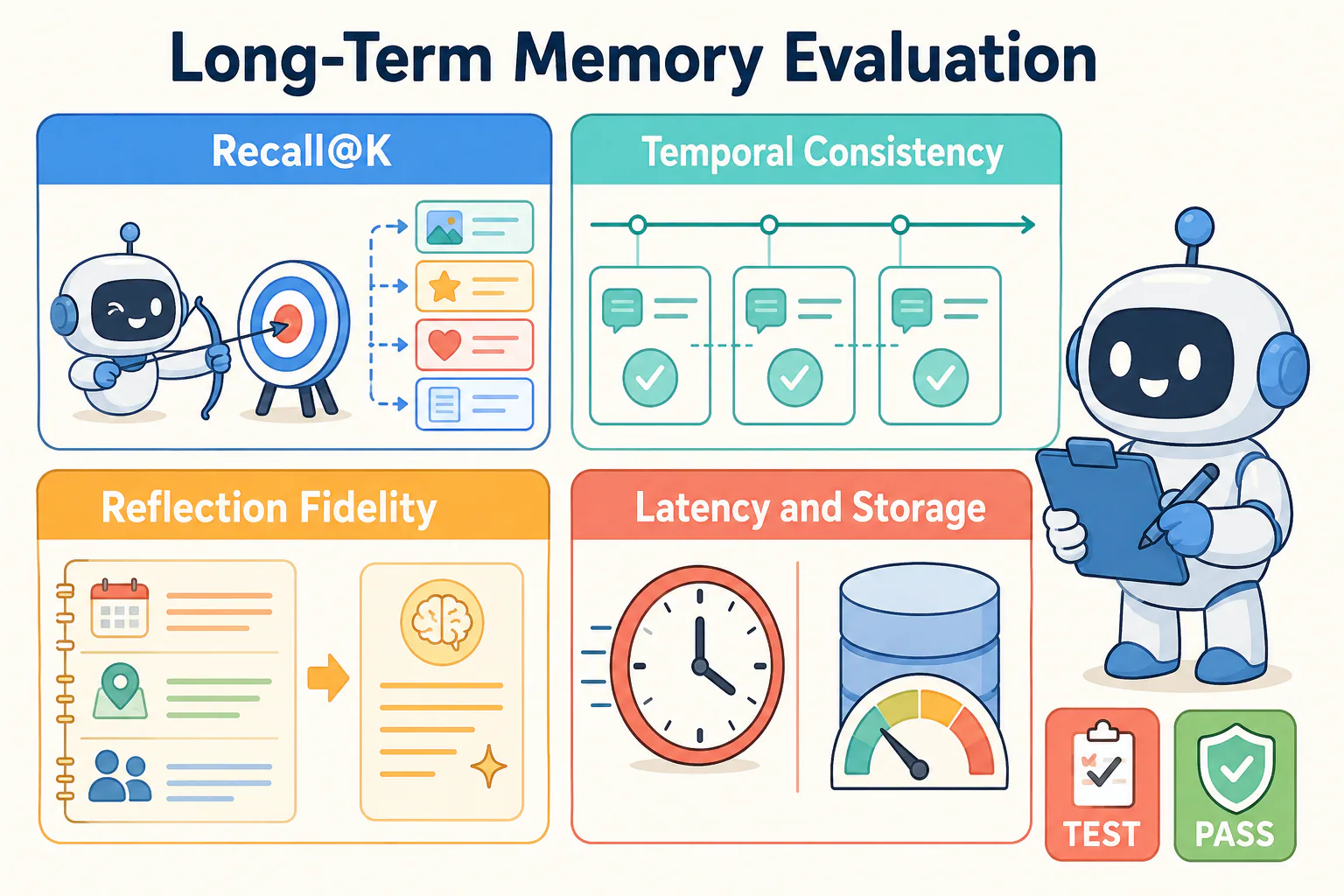
Figure 3. Quantitative memory evaluation dashboard. Core metrics monitor retrieval precision, temporal stability, synthesis fidelity, and search latency.
Main variants
Section titled “Main variants”- Recursive reflection trees (Generative Agents): Maintains a multi-layered directed acyclic graph (DAG) of memories where high-level abstract nodes point downward to supporting lower-level episodic observations (Park et al., 2023).
- Ebbinghaus memory banks (MemoryBank): Models human biological memory retention with continuous decay curves and spaced repetition reinforcement, strengthening memory nodes every time they are recalled (Zhong et al., 2024).
- Conversational search benchmarking (MemGPT / LoCoMo): Evaluates agent memory systems against challenging long-range question answering datasets that require multi-session cross-thread reasoning (Packer et al., 2023).
Minimal implementation
Section titled “Minimal implementation”The following Python snippet demonstrates memory reflection synthesis, contradiction resolution, decay pruning, and automated evaluation benchmarking. The full runnable example demonstrates multi-step benchmark scoring.
Expand minimal Python implementation
from dataclasses import dataclass, fieldfrom datetime import datetime, timezone, timedeltaimport mathfrom typing import Dict, List, Optional
@dataclassclass MemoryNode:    id: str    content: str    salience: float    created_at: datetime    last_accessed: datetime    tier: str  # "episodic" or "semantic"    source_ids: List[str] = field(default_factory=list)    is_deprecated: bool = False
class MemorySystem:    def __init__(self, decay_rate: float = 0.90) -> None:        self.memories: Dict[str, MemoryNode] = {}        self.decay_rate = decay_rate
    def consolidate_reflection(self, query_topic: str, synthesis_text: str, salience: float) -> MemoryNode:        matching_ids = [            m.id for m in self.memories.values()            if m.tier == "episodic" and not m.is_deprecated and query_topic.lower() in m.content.lower()        ]        now = datetime.now(timezone.utc)        insight = MemoryNode(            id=f"insight-{len(self.memories)}", content=synthesis_text, salience=salience,            created_at=now, last_accessed=now, tier="semantic", source_ids=matching_ids        )        self.memories[insight.id] = insight        return insight
    def prune_decayed(self, threshold: float = 0.3, current_time: Optional[datetime] = None) -> int:        now = current_time or datetime.now(timezone.utc)        evicted = []        for mid, mem in list(self.memories.items()):            if mem.is_deprecated:                evicted.append(mid)                continue            days = max(0.0, (now - mem.last_accessed).total_seconds() / 86400.0)            score = mem.salience * math.pow(self.decay_rate, days)            if score < threshold and mem.tier == "episodic":                evicted.append(mid)        for mid in evicted:            del self.memories[mid]        return len(evicted)
Run consolidation_evaluation_runtime.py to inspect episodic consolidation, contradiction deprecation, decay pruning, and benchmark evaluation.
Data flow and state changes
Section titled “Data flow and state changes”- Episodic recording: Live dialogue events and tool execution traces are written to the Level 0 episodic stream.
- Periodic trigger: The reflection worker triggers when episodic records exceed a threshold or on a scheduled cron schedule.
- Clustering and synthesis: An LLM groups related events, generates synthesis questions, and derives high-level semantic rules.
- Provenance tagging: New semantic nodes are linked to their originating Level 0 episodic record IDs.
- Decay evaluation: The pruning worker calculates current retention scores $R(t)$ for unaccessed memories.
- Prune execution: Expired TTL entries and decayed low-salience records are permanently purged from vector and document storage.
- Regression benchmarking: Automated evaluation suites query the updated store, verifying recall precision and consistency.
Trust boundaries
Section titled “Trust boundaries”- Reflection validation boundary: Synthetic memories generated during reflection must not inherit or amplify unverified claims from untrusted external tool outputs.
- Contradiction validation: In-place preference updates must be verified against authentic user session authority to prevent unauthorized actors from overwriting profile settings.
- Complete deletion guarantee: Right-to-be-forgotten deletion must cascade across all secondary indices, vector caches, and replica stores, ensuring zero residual data retention.
Reliability failures
Section titled “Reliability failures”- Hallucinatory reflection synthesis: A background reflection model may summarize unrelated events into a flawed causal rule (e.g., assuming a single failed database query means the entire database is decommissioned).
- Over-pruning critical rare instructions: A pure time-decay forgetting curve without intrinsic salience weighting will accidentally delete rarely accessed but vital safety guidelines.
- Cascade corruption: If a flawed reflection node is written to semantic memory, subsequent reflection cycles will build upon this false foundation, compounding errors across the memory graph.
Limitations and trade-offs
Section titled “Limitations and trade-offs”- Compute and token overhead: Continuous background reflection and periodic benchmark evaluations require recurring LLM compute resources.
- Reconciliation ambiguity: Automatically resolving contradictory statements without human clarification risks discarding valid context nuances.
- Evaluation coverage: Synthetic benchmark queries may not fully anticipate edge-case queries encountered in live user interactions.
Security preview
Section titled “Security preview”In Pass 2, memory consolidation and evaluation systems are analyzed under Reflection Poisoning and Invalidation Bypass Attacks. Attackers attempt to seed subtle episodic traces across multiple separate sessions that, when processed by background reflection models, synthesize backdoors into semantic memory. We examine multi-stage provenance verification, anomaly detection, and sanitization pipelines in Retrieval, memory, and data security.
Open research questions
Section titled “Open research questions”- How can reflection models autonomously assess their own confidence before committing synthesized insights to long-term memory?
- What mathematical criteria can differentiate between an evolving user preference and a transient situational exception?
Key takeaways
Section titled “Key takeaways”- Memory consolidation synthesizes granular episodic events into durable, high-level semantic insight trees.
- Principled forgetting models combine Ebbinghaus exponential decay, TTL expiration, contradiction invalidation, and compliance deletion.
- Provenance links must connect abstract reflections back to original episodic sources for auditability.
- Quantitative benchmarks evaluate memory quality across Recall@K, temporal consistency, reflection fidelity, and query latency.
References
Section titled “References”- Park, J. S., O’Brien, J. C., Cai, C. J., Morris, M. R., Liang, P., & Bernstein, M. S. (2023). Generative Agents: Interactive Simulacra of Human Behavior. In Proceedings of the 36th Annual ACM Symposium on User Interface Software and Technology (UIST ’23), pp. 1-22. DOI: 10.1145/3586183.3606763.
- Packer, C., Fang, V., Patil, S. G., Lin, K., Wooders, S., & Gonzalez, J. E. (2023). MemGPT: Towards LLMs as Operating Systems. arXiv preprint arXiv:2310.08560. MemGPT Paper.
- Zhong, W., Guo, L., Gao, Q., Ye, H., & Wang, Y. (2024). MemoryBank: Enhancing Large Language Models with Long-Term Memory and Forgetting Mechanisms. arXiv preprint arXiv:2305.10250. MemoryBank Paper.