
Interrupts, steering, feedback, and operator experience
Distinguish interruption requests from acknowledged pauses, then apply steering, feedback and takeover to a recorded run state.
- Explain cooperative interruption and framework restart semantics.
- Separate task steering from approval and feedback from training.
- Describe an operator interface and measurable response objectives.
Why this matters
Section titled “Why this matters”While the assistant drafts a pickup message, Lee says “Change this to a delivery request.” The application needs to know whether a message was already sent, whether the worker has paused and which draft belongs to the revised goal. Adding Lee’s text to context does not by itself stop an operation already in progress.
This chapter extends the approval lifecycle to intervention during work. It connects execution with the state shown to a human operator.
How it works
Section titled “How it works”A request to stop is not an acknowledged stop
Section titled “A request to stop is not an acknowledged stop”An interruption breaks the normal workflow so another event or decision can be handled. A pause request asks the runtime to reach a point where it can stop continuing the run. A checkpoint records state needed to continue later. A cancellation request asks for work to end; the runtime must report whether that happened and which effects remain.
In a cooperative design, the worker notices an interruption at a defined execution boundary. A long synchronous operation may not notice immediately. Python’s asyncio cancellation delivers CancelledError at a later opportunity, and cleanup belongs in try/finally. This describes local task behavior, not the state of an order service the task already contacted. Python 3.12 task cancellation.
Our interface therefore distinguishes “Pause requested” from “Paused.” It does not announce that an external action stopped until its outcome is known. An uncertain send operation requires reconciliation with the messaging service.
Steering changes the task being pursued
Section titled “Steering changes the task being pursued”Steering changes the goal, constraints or next steps of an active task. Feedback supplies an assessment or correction, such as “the draft has the wrong address.” Takeover transfers task ownership to a human who performs the next steps directly. These inputs differ from approving an existing proposal.
Our design pauses at a boundary, records a new goal version and invalidates drafts and pending proposals that depend on the previous goal. Work already completed remains in the record. Resumption uses the revised goal to choose future steps. Takeover leaves the task human-owned, so the automated worker does not also continue it.
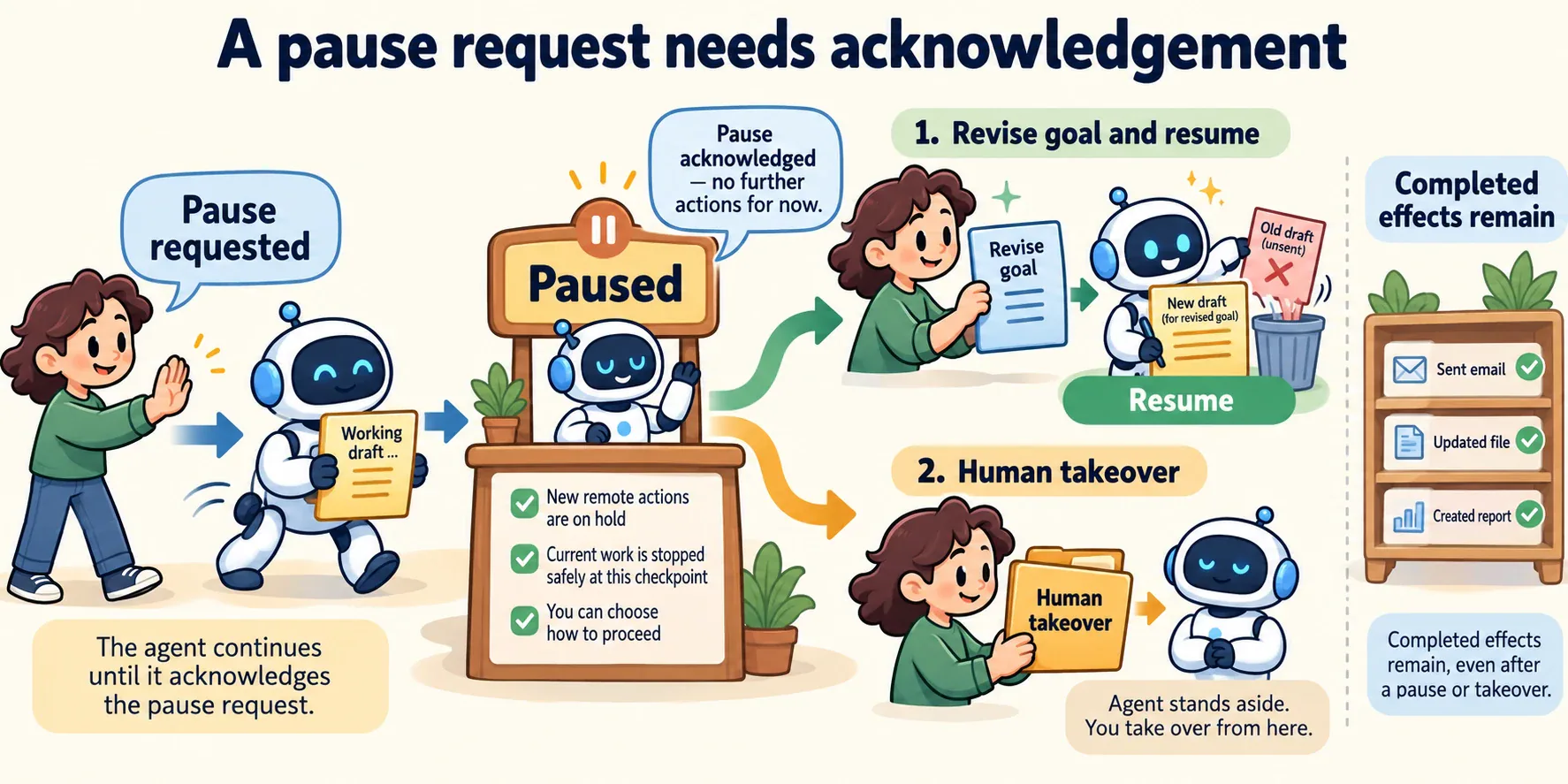
Figure 1. Follow the acknowledgement before steering. The revised goal creates a new draft, while takeover transfers ownership. Earlier completed actions remain part of the history.
Understand what a framework resumes
Section titled “Understand what a framework resumes”LangGraph interruptions use a checkpointer and thread ID to preserve the run’s state. Resumption supplies a value through Command. The interrupted node restarts from its beginning, so code before the interruption runs again. Place externally visible effects with those restart semantics in mind; saving state is not the same as reversing an effect. LangGraph interrupts.
Our mock uses explicit methods rather than framework nodes. It demonstrates a chosen application contract, not LangGraph’s exact execution mechanism. A different runtime may resume at a different boundary or require restarting an operation.
Some runtimes accept updates while work is running
Section titled “Some runtimes accept updates while work is running”Steering need not always start with an explicit pause. Compatible runtimes can queue a new user instruction during a response. Show whether the update was received, queued or applied. Previously emitted output and started tools may remain in effect.
For example, OpenAI documents mid-turn steering for the GPT-6 family over Responses API WebSockets. A queued update can produce a continuation after current output and hosted tool work finish. This differs from the pause-and-resume contract of our offline example. Verify model and transport support; do not infer that steering cancels an external action. Mid-turn steering.
Make operator state understandable
Section titled “Make operator state understandable”An operator is a person responsible for observing or managing the workflow. The interface should show the active task, latest known step, pending human decisions, completed effects, uncertain outcomes and available interventions. “Working” is too vague when the system is actually waiting for a reviewer.
Amershi and colleagues’ human-AI interaction guidelines recommend communicating system capabilities and limits, supporting dismissal and correction, and allowing feedback and control. We apply those ideas to run state and interventions; their research does not establish that an approval button guarantees correct decisions. Guidelines for Human-AI Interaction.
For Lee’s delivery change, show that the old note is unsent, the run is paused and the new delivery draft is being prepared. If the old note was sent, say so and explain what next step is available. The interface should describe observed effects, not the model’s speculative account of them.
Minimal implementation
Section titled “Minimal implementation”The offline interruption example records a pause request, acknowledges it at a boundary, revises the goal and clears the dependent draft. It tests that steering before acknowledgement is refused. A later takeover records human ownership.
Expand minimal Python implementation
run.request_pause()# The worker reaches a defined boundary:run.boundary()run.steer("Prepare a delivery note")run.resume()The script has no simultaneous workers, remote calls or saved database. It illustrates the transitions that a real implementation must coordinate. It also does not train a model. Recorded feedback can inform a future prompt or offline evaluation; updating model parameters is a separate process.
Limitations and trade-offs
Section titled “Limitations and trade-offs”Frequent interruptions can prevent useful progress. Slow acknowledgement can make an interface feel unresponsive even when it has received the user’s message. Define a service-level objective, a measurable target for service behavior, such as acknowledging 95% of pause requests within two seconds under a specified workload. This number is illustrative, not a recommended universal threshold.
Measure acknowledgement delay, time waiting for human input, reviewer queue size and the fraction of tasks requiring takeover. Observability will show how those records relate to complete runs. Averages alone can hide a small number of very slow interventions.
Security preview
Section titled “Security preview”Pass 2 examines misleading state displays and approval fatigue in human interfaces and observability security. The architecture must first distinguish requested intervention, acknowledged state and completed effects.
Key takeaways
Section titled “Key takeaways”- Record the request to intervene separately from acknowledgement.
- Steering revises the goal; approval accepts a proposal; takeover changes task ownership.
- Know the framework’s restart boundary before resuming work with side effects.
- Show observed state and measure intervention delays and workload.
Check your understanding
Does requesting pause mean the run is already paused? No. The runtime acknowledges pause at its defined intervention point.
References
Section titled “References”-
LangChain. LangGraph interrupts. Living documentation, verified for this run.
-
Python Software Foundation. Python 3.12 coroutines and tasks.
-
Amershi et al. Guidelines for Human-AI Interaction. CHI 2019. DOI: 10.1145/3290605.3300233.
-
OpenAI. Mid-turn steering. Living documentation, verified October 10, 2026.